
BLOG

Should You Buy Property Now or Wait for Lower Rates?
Should You Buy Property Now or Wait for Interest Rates to Drop?
Should you buy an investment property now, or wait until interest rates come down?
It sounds like a simple question. The answer usually surprises people.
Before we go further, one thing needs saying.
This is not a piece designed to push you into buying today.
Not everyone is ready.
Some buyers do not have the deposit yet. Some do not have the borrowing capacity. If that is you, keep building your position, and this article is not aimed at you.
This is for buyers who are ready.
You have the deposit. You have the capacity. And you are sitting on the fence, wondering whether it is smarter to move now or hold off for two years until rates are lower.
The short answer
If you can afford to buy a sound asset now, waiting for lower interest rates usually costs you more than it saves.
The interest you avoid by waiting tends to be smaller than the growth you miss, because prices keep moving and you hold the asset for fewer years.
In the model below I tested four ways to play the wait.
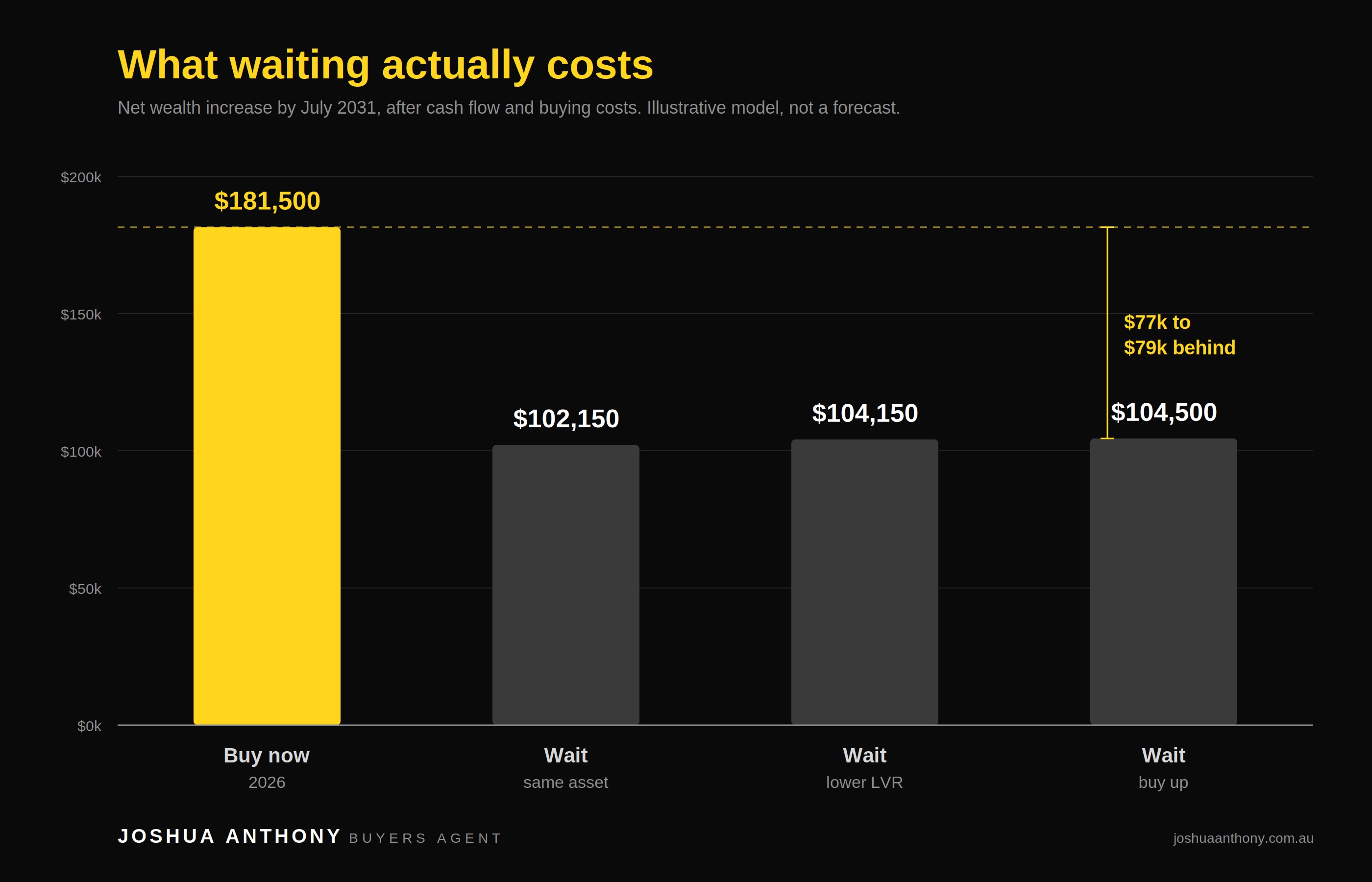
After counting cash flow and buying costs, every one of them finished roughly $77,000 to $79,000 behind simply buying on time, on the same assumptions and the same market.
Now let me show you the working, so you can judge it for yourself.
A note on the numbers
Everything below is a worked example. The figures are round-number assumptions chosen to show how the mechanism works. They are not forecasts, and they are not a claim about what any specific market will do.
Acquisition costs like stamp duty, legals and inspections are assumed at about 5% of the purchase price, which varies by state.
Every real deal has to be run on its own numbers. Use this to understand the logic, not to price a purchase.
The setup
Our buyer has $150,000 in cash in 2026. That covers a deposit plus acquisition costs.
They use an 80% lending ratio, and their repayments are interest only.
We assume:
Growth of 7% per year, held steady across every scenario
Interest rates starting around 6.5% and easing toward 5.5% over the first few years
A gross rental yield in the mid 4% range on the lower price point
Standard holding costs: management fees, rates, insurance and maintenance, rising modestly each year
Acquisition costs of about 5% of the purchase price
One realistic detail matters for the scenarios that wait.
If our buyer does not buy in 2026, they keep saving. By 2028 they have added roughly $35,000, so they are sitting on about $185,000. We hold that in mind as we go.
Same buyer. Same assumptions. We change one thing at a time.
Scenario 1: Buy the asset now, in 2026
This is our baseline. Everything else measures against it.
With $150,000, our buyer purchases a $600,000 property and borrows $480,000 at around 6.5%. Of that cash, about $30,000 goes on acquisition costs, and the rest is the deposit.
The early years carry a negative cash flow. In year one, the shortfall is roughly $11,000.
As rents rise and rates ease, that gap narrows each year and moves close to neutral by year five. Across the full five years, the total cash flow cost lands around $30,000.
Now the growth. At 7% per year, a $600,000 property becomes roughly $841,500 by July 2031. That is an equity gain of about $241,500.
Subtract the $30,000 of cash flow cost and the $30,000 of acquisition costs, and the net wealth increase is about $181,500.
Hold that number. It is the one to beat.
Scenario 2: The same asset, two years later
Here we change only one thing. The timing.
Same buyer. Same property. Same quality, same market.
They wait two years and buy in 2028, now with the $185,000 they have saved.
But the property did not wait for them. At 7% growth, the same house that cost $600,000 in 2026 now costs about $687,000 in 2028. Holding the same 80% ratio, they borrow $549,600. Acquisition costs rise with the price, to about $34,350.
Rates are lower now, around 5.5%, so holding is a touch cheaper. Across a three-year hold, the cash flow cost is around $18,000.
By July 2031, the property is worth the same $841,500 it was always going to be worth. The end value does not change, because it is the same house.
What changes is the entry price and the time held. The equity gain is only about $154,500, because they bought in higher and held for fewer years.
Subtract the cash flow cost and the higher acquisition costs, and the net wealth increase is about $102,150.
Compare that to Scenario 1. Waiting on the identical asset cost this buyer around $79,000. Nothing else moved. Just two years on the clock.
And notice this: the money they hoped to save by waiting was largely swallowed by the higher deposit and the bigger stamp duty bill the same house now demanded. Running to stand still.
Scenario 3: The same asset, but borrow less
Here is a fair objection. If I wait and save, I could put more down and carry less debt. Surely that helps.
Same buyer, same $185,000, same $687,000 house. This time they tip the full amount in rather than holding the extra as spare cash. After costs, the deposit is about $150,650, the loan drops to $536,350, and the lending ratio LVR falls to around 78%.
A smaller loan means a slightly smaller interest bill, so the three-year cash flow cost eases to around $16,000. But the equity gain is unchanged at about $154,500, and the acquisition costs are the same $34,350, because it is the same house at the same price.
Net wealth increase: about $104,150.
That is only about $2,000 better than Scenario 2, and still around $77,000 behind buying on time.
This is the quiet lesson. Borrowing less lowers your risk and improves your serviceability, which are real benefits. It does not recover lost growth. Your equity is driven by the asset and the years you hold it, not by how much of it you paid for in cash.
Scenario 4: Wait, then buy a better asset
Now let me steel-man the strongest case for waiting. Most people who wait plan to buy up.
Same buyer, same $185,000. This time they use it to step up to a stronger $740,000 property, borrowing $592,000 at 80%. The dearer house also carries a bigger acquisition bill, about $37,000.
Better asset. Higher end value. By July 2031, at the same 7% growth, it reaches roughly $906,500. That is an equity gain of about $166,500, more than any of the earlier waiting scenarios.
The three-year cash flow cost is around $25,000, a little higher because the loan is larger.
Subtract the cash flow cost and the acquisition costs, and the net wealth increase is about $104,500.
So trading up helped, but only just.
Once you count the extra stamp duty on the pricier house, it barely beats simply borrowing less on the original property, and it still finished about $77,000 behind buying on time, using every dollar of the $185,000 to get there.
Buying a better property could not rescue the lost time.
The four scenarios side by side
Measure | Buy now (2026) | Wait, same asset (2028) | Wait, lower LVR (2028) | Wait, buy up (2028) |
|---|---|---|---|---|
Interest rate at purchase | 6.5% | 5.5% | 5.5% | 5.5% |
Purchase price | $600,000 | $687,000 | $687,000 | $740,000 |
Deposit | $120,000 | $137,400 | $150,650 | $148,000 |
Loan amount | $480,000 | $549,600 | $536,350 | $592,000 |
Loan-to-value (LVR) | 80% | 80% | 78% | 80% |
Hold to July 2031 | 5 years | 3 years | 3 years | 3 years |
Growth assumed | 7% p.a. | 7% p.a. | 7% p.a. | 7% p.a. |
Estimated value July 2031 | $841,500 | $841,500 | $841,500 | $906,500 |
Equity gain (growth) | $241,500 | $154,500 | $154,500 | $166,500 |
Less cash flow cost | -$30,000 | -$18,000 | -$16,000 | -$25,000 |
Less acquisition costs (5%) | -$30,000 | -$34,350 | -$34,350 | -$37,000 |
Net wealth increase | $181,500 | $102,150 | $104,150 | $104,500 |
A quick word on how to read that "equity gain" line. It means growth in the property's value only. Your deposit is not counted as a gain, because it is your own money, not growth, and it sits in your position at both the start and the end. The net wealth line then subtracts the two costs that are genuinely lost: the cash flow you fund along the way, and the buying costs you never see again.
What the numbers actually tell us
Read the four results together and the story is hard to miss.
Scenario 2 is the clean control. Same asset, only the timing changed, and waiting cost about $79,000. That is the pure price of two years out of the market.
Scenario 3 answers the safety objection. Borrow less on the same asset and you barely move the outcome, about $2,000. Lower leverage is worth having, but it does not buy back time.
Scenario 4 answers the ambition objection. Save more, buy a better property, and you get the best of the waiting outcomes. It still lands about $77,000 behind, and once the higher stamp duty is counted it barely beats simply borrowing less on the original home.
Three different ways to make waiting pay. All three finished behind. The old line proves out, from several angles at once:
"Time in the market almost always beats timing the market".
Chasing a lower interest rate is chasing a smaller number while a bigger one moves away from you.

What if you genuinely cannot afford the property you want?
This is the more useful question, and it is where many buyers get stuck.
Plenty of people have watched their borrowing capacity shrink. They cannot fund the property they really want, in the market they really want. So they wait, hoping the gap closes.
The better question is not whether to buy the perfect property now or wait until you can afford it. It is how to adjust your strategy so you get exposure to growth sooner.
The environment keeps changing. Informed buyers adapt to it. A few ways to do that:
Consider a different market. If a capital city is out of reach, a strong regional centre may not be. The test is not the postcode. It is whether the local economy is resilient, the drivers are real, and the conditions genuinely support growth.
Consider a different asset. Townhouses have drawn strong interest while rates have stayed high. Over the very long run their capital growth may not match a well-located house, and that varies market to market, so treat it as a case-by-case call rather than a rule. But as an entry point that is more affordable and moving well right now, the right one can be a smart stepping stone, with a view to upgrading later.
The point is simple. Getting into a sound asset usually beats sitting out for the perfect one.
Frequently asked questions
Should I buy an investment property now or wait for interest rates to drop?
If you have the deposit and borrowing capacity, buying a sound asset now usually builds more wealth than waiting for lower rates, because you capture more years of compounding growth. Waiting to save on interest often costs more in missed growth than it saves.
Does waiting for lower interest rates save money?
It can reduce your holding costs, but prices usually rise while you wait. In a growing market the higher purchase price, the extra stamp duty, and the shorter time you hold the asset tend to outweigh the interest you save.
Does putting down a bigger deposit make waiting worthwhile?
A bigger deposit lowers your loan and your risk, but it barely changes the wealth outcome. Your equity growth is fixed by the asset and how long you hold it, so borrowing less does not recover the growth you skipped by waiting.
Is it better to buy a cheaper property now or a better one later?
In this model, buying the original asset on time still finished ahead of waiting and trading up to a more expensive property later. A shorter holding period, plus the extra stamp duty on the dearer house, limits the upside no matter how good the asset.
What if I cannot afford the property I want right now?
The better question is how to adjust your strategy to enter sooner. That can mean a more affordable but resilient market, or a different asset type such as a well-located townhouse as a stepping stone, rather than sitting out until you can afford the ideal property.
The bottom line
Waiting feels safe. It rarely is.
The cost of waiting is quiet, it does not show up on a bank statement, and by the time you notice it, the growth has already happened without you.
None of this means rush.
It means the decision is not now versus a lower rate. It is a sound asset now versus a bigger gap later.
Get the asset right and it becomes a genuine financial asset. Get it wrong and it becomes your worst financial burden. That is the part worth slowing down for.
If you are ready to move and you want a second set of eyes on the numbers before you commit, that is exactly what we do.
Book a 15 minute call and we will pressure test your plan, market by market, on your real figures. And if borrowing capacity is your constraint, that is a conversation for a good mortgage broker, and I am happy to point you to one.
Buy it right the first time and the property becomes a great financial asset. Do it wrong and it becomes your worst financial burden.
Let us make sure you are on the right side of that line.
Joshua Anthony | Property Acquisition Specialist | Buyers Agent
📲 0419 815 575 | 📩 hello@joshuaanthony.com.au | 🌐 joshuaanthony.com.au
This article is general information only. It does not take into account your personal circumstances, objectives or financial situation, and it is not financial, tax or credit advice. The figures used are illustrative assumptions, not forecasts. Please consult the relevant qualified professionals before making any property or finance decision.

Quick Links
Social Media Links