
Case Study
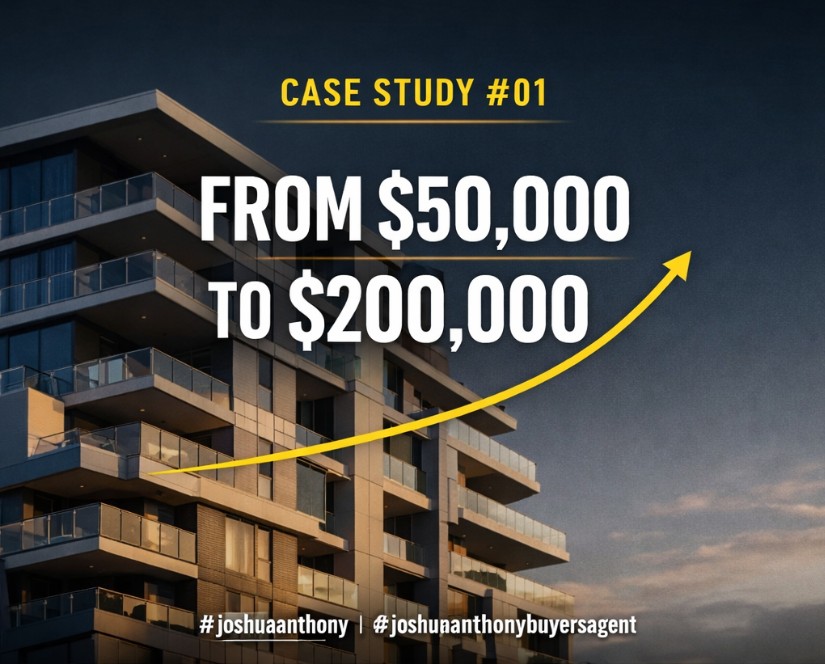
Case Study #1 - Estimate vs Evidence: A $200,000 Case Study
The $80,000 Estimation Gap
Why Online Valuations Can Mislead Investors
(Client name and minor details changed for privacy)
The Acquisition
In July 2024, we secured a well-positioned apartment for $500,000.
Client capital contributed: $50,000 deposit
Funding structured strategically to optimise leverage.
The objective was clear:
✅ Low-maintenance asset
✅ Strong rental demand
✅ Solid location fundamentals
✅ Positioned for capital growth
This was not a speculative purchase.
It was a calculated acquisition.
The Market Position – February 2026
During a recent portfolio review, the client estimated the property’s value at $620,000, based on an online valuation tool.
However, two weeks prior to our meeting, a near-identical apartment in the same complex sold for: $700,000!
Same layout.
Same building.
Comparable condition.
That sale represents current market evidence.
Financial Outcome
➡️Purchase Price (July 2024): $500,000
➡️Recent Comparable Sale: $700,000
➡️Capital Growth: $200,000
➡️Timeframe: ~19 months
➡️Initial capital invested: $50,000
➡️Return on cash invested: 400%*
(*Before costs and holding expenses)
This is the power of structured leverage combined with correct asset selection.
The Strategic Insight
Online estimators are algorithm-based guides.
They:
• Lag behind settled sales
• Apply broad modelling
• Do not account for micro-level movements
• Often understate or overstate in fast-moving markets
Serious investment decisions should be based on real comparable evidence — not automated estimates.
The Leverage Effect
A $200,000 uplift in value creates optionality:
• Portfolio expansion
• Refinancing flexibility
• Capital reallocation
• Long-term wealth acceleration
Growth alone is not the objective.
Strategic positioning is.
Key Takeaway
Property outcomes are rarely accidental.
When asset selection, market timing, and leverage are aligned, results compound.
This case study demonstrates the difference between:
Estimating value and Understanding value.
Considering your own portfolio position?
If you’re unsure how your property compares to recent market evidence, reviewing comparable sales may reveal opportunities you didn’t realise existed.
Case Study #2 - From Reactive Bidding to Strategic Control
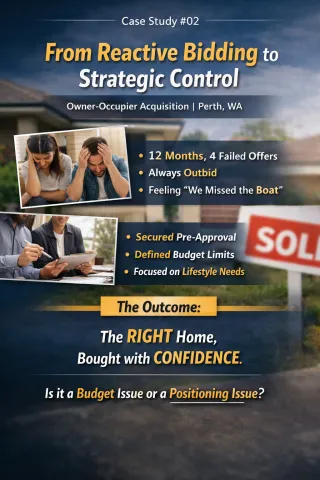
From Reactive Bidding to Strategic Control
Competitive Market Acquisition | Perth, WA
(Client name and minor details changed for privacy)
The Situation
When the client first engaged us, they had been on the market for nearly 12 months.
Over that period:
• Multiple offers submitted
• Consistently outbid
• Increasing price pressure
• Growing emotional fatigue
Frustration had turned into doubt.
They felt like:
• They had “missed the boat.”
• Prices had run away from them.
• Every property was selling before they could secure it.
Worse still, the decision-making environment had shifted from considered to reactive.
Offers were being made under pressure.
Finance clauses were being removed.
Building and pest conditions were waived.
All in an attempt to compete.
Without fully understanding the risk exposure.
The Core Problem
There was no structured acquisition strategy.
Specifically:
❌ No formal pre-approval in place or lending clarity
❌ No defined suburb hierarchy
❌ No clear maximum purchase boundaries
❌ No due diligence framework
❌ No controlled negotiation plan
Every property was treated as urgent.
Every offer was emotional.
In competitive markets, that combination is dangerous.
The Reset
Before inspecting another property, we paused the search.
We worked closely with the client and their mortgage broker to establish:
1️⃣ Maximum Borrowing Capacity - Clear lending approval parameters.
2️⃣ Total Acquisition Costs - Stamp duty, settlement costs, inspections, contingency allowances.
3️⃣ True Maximum Purchase Limit - A defined ceiling that would not be exceeded — regardless of pressure.
This created clarity.
Clarity restored control.
Lifestyle Alignment
With financial boundaries defined, we restructured the search around what truly mattered:
• Proximity to family and support networks
• Work commute practicality
• School access and long-term suitability
• Street quality and neighbourhood feel
• Layout functionality for future family needs
Suburbs were selected based on lifestyle alignment — not panic availability.
The Strategic Framework
With financial boundaries defined, we implemented structure:
• Ranked micro-locations based on lifestyle dynamics
• Established asset selection criteria
• Locked in a non-negotiable due diligence checklist
• Structured offers to remain competitive without reckless clause removal
The focus shifted from:
“Win at any cost”
to
“Secure correctly within defined limits.”
The Outcome
Within a short period after implementing structure, we secured a property aligned with the original objectives:
✅Within budget
✅In a competitive suburb
✅With appropriate protections in place
✅Without unnecessary clause removal
Importantly: The client purchased with confidence — not pressure.
With clarity — not compromise.
The Strategic Insight
Many buyers believe they are losing because:
“They aren’t offering enough.”
In reality, there are two common issues:
1️⃣ Competing Without Structure
• No financial clarity.
• No defined ceiling.
• No due diligence framework.
• No negotiation plan.
And equally important:
2️⃣ Failing to Inspire Confidence
In competitive markets, price alone does not win.
The selling agent’s priority is clear:
• Secure a serious buyer.
• Minimise risk to the seller.
• Avoid contract fallout.
If an offer appears rushed, poorly structured, or financially uncertain, it increases perceived risk.
And risk makes sellers hesitate.
A strategically prepared buyer demonstrates:
• Clear lending capacity
• Defined financial boundaries
• Contractual understanding
• Decisive yet controlled action
That confidence is felt in negotiation.
And confidence influences outcomes.
Winning is not just about offering more.
It is about presenting as the most secure and reliable buyer.
Key Takeaway
Fatigue leads to poor decisions.
Pressure leads to risk.
Structure restores control.
If you’ve been repeatedly outbid, the issue may not be budget.
It may be positioning, preparation, and process.
Final Question
If you’ve been repeatedly outbid, is it truly a budget issue…
Or is it a positioning issue?
Case Study #3 - Coming Soon
Coming Soon ...
Quick Links
Social Media Links